
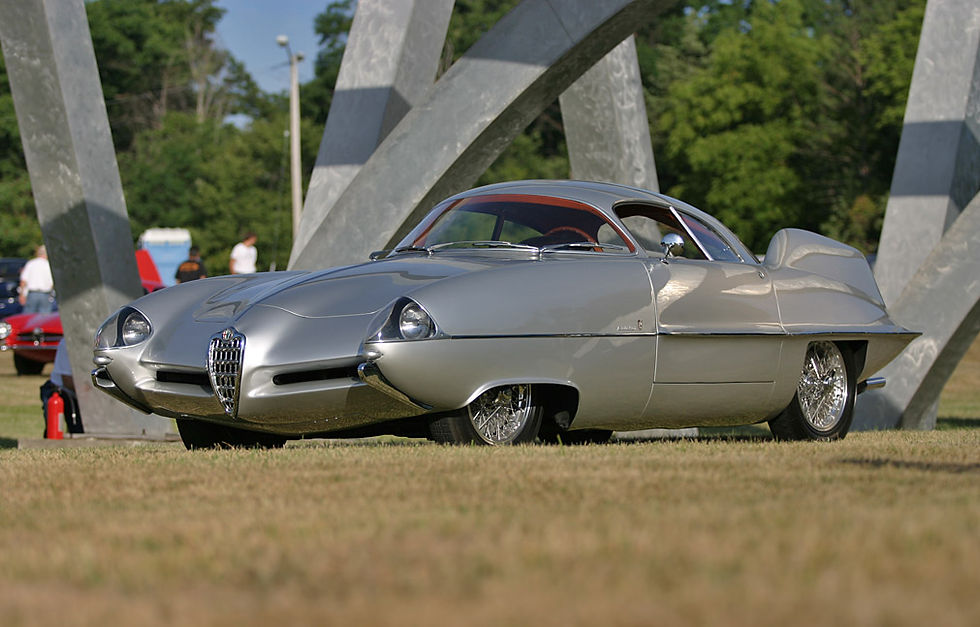
Alfa Romeo B.A.T. 9d, 1955
- 3 февр.
- 2 мин. чтения
The Alfa Romeo BAT (or Berlina Aerodinamica Tecnica) is a series of Italian prototypes.

These cars were the result of a joint project between Alfa Romeo and the Italian coachbuilder Bertone, begun in 1953. Three examples were built: the BAT 5 in 1953, the BAT 7 in 1954, and the BAT 9 in 1955. All three were designed by Franco Scaglione.
Alfa Romeo commissioned Nuccio Bertone of the Bertone coachbuilder to create three prototypes to study the effect of aerodynamic drag on a car. The goal was to create cars with the lowest possible drag coefficient. They were built on the Alfa Romeo 1900 chassis. Each of the three cars was unveiled at the Turin Motor Show in 1953, 1954, and 1955, respectively. The lowest drag coefficient of the three cars was 0.19, a remarkable figure even by today's standards. Each Alfa Romeo was equipped with a five-speed manual transmission and a powerful four-cylinder engine producing over 90 horsepower (67 kW), enabling it to reach a top speed of 201 km/h (125 mph).

All three original BATs have been restored and exhibited at prestigious car shows such as the Concorso Italiano and the Pebble Beach Concours d'Elegance. They were on display at the Blackhawk Museum in Danville, California, from 2005 to July 2017. In 2020, RM Sotheby's auction house sold all three cars together for US$14.84 million, including buyer's commission. The third BAT model, the BAT 9d, was unveiled at the 1955 Turin Motor Show. Its design was intended to be more reminiscent of existing Alfa Romeo models than other BAT models. The BAT 9 abandoned the pronounced fender lines of previous models in favor of a cleaner, more understated design. The rear fins, which had a true fender shape on the other two models, were reduced to two small metal fins, similar to those used on American and some European cars of the period.
Technical data
Engine: in-line, 4 cylinders
Displacement: 1975 cc
Power: 115 hp
Top speed: 180 km/h

Sources:


Комментарии